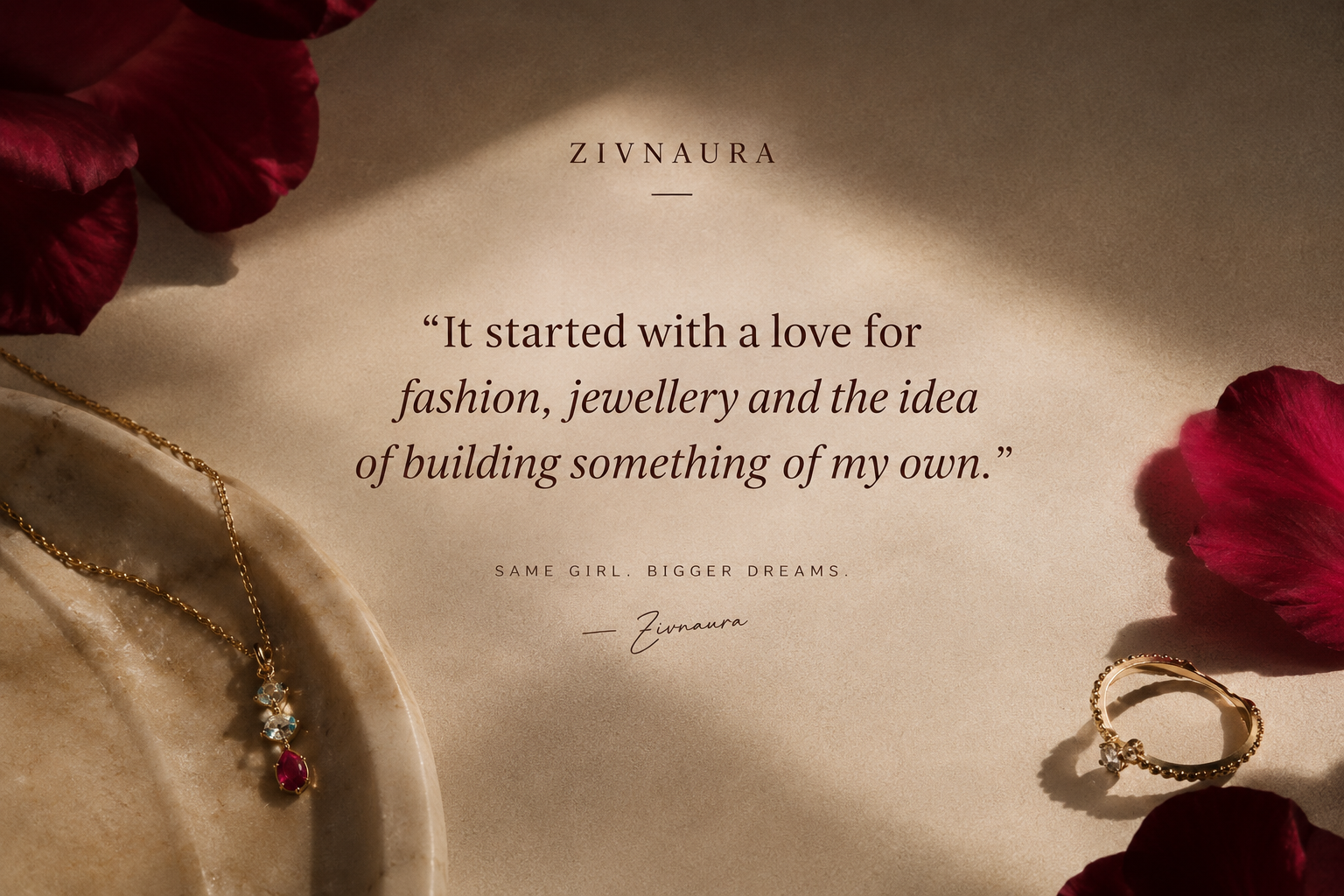
What does it take to turn an idea into a brand when you are still figuring things out yourself?
Sunday Feature | Edit 001 – The Peel Off Press
In a world where new businesses appear on our feeds every day, it is easy to believe that building a brand begins with a perfect idea, a flawless launch and a clear picture of what success should look like. We see the finished products, the carefully curated Instagram grids and the branding that makes everything look effortless. What we rarely see is the work that happens before any of it comes together.
That is where the story of Zivnaura, an anti-tarnish jewellery brand focused on stylish, affordable and durable pieces for everyday wear, begins. Built from an interest in fashion, jewellery and entrepreneurship, Zivnaura grew out of a simple observation: everyday jewellery should feel as practical as it is beautiful. Its founder wanted to create pieces that people could incorporate into their daily style without feeling that good design had to come at the expense of affordability or practicality.
But turning that idea into a business meant learning much more than how to choose jewellery. It meant understanding how to build a brand, connect with customers and keep moving when the answers were not always obvious. And that is precisely why Zivnaura became the first story featured on The Peel Off Press’s Sunday Feature.
IT STARTED WITH JEWELLERY. THEN CAME THE WORK OF BUILDING A BRAND.
The idea behind Zivnaura came from a love of fashion and jewellery, alongside the desire to build something of her own. The opportunity was to create everyday jewellery that brought together style, affordability and durability, making it suitable for regular wear rather than something reserved only for special occasions.
Zivnaura was built around that idea, with anti-tarnish jewellery at the centre of its identity. Yet identifying a gap in the market is only the beginning of entrepreneurship. An idea becomes a business when someone is willing to take responsibility for everything required to bring it to life, including the parts they may never have planned to learn.
Once Zivnaura began, the work quickly expanded beyond product selection. Marketing needed attention, content had to be created, advertising required experimentation, customer queries needed responses and the brand’s identity had to become clearer. The founder found herself stepping into several roles at once: content creator, marketer, advertiser, product curator, customer communicator and brand-builder.
For a young entrepreneur, that learning curve can be considerable. There is no single instruction manual that explains how to make every decision, and knowing what a brand should stand for does not automatically tell you how to communicate that identity to the world. Each responsibility brings its own questions, and each answer often comes through experience.
This is the less visible side of building a small business. The product may be what customers see first, but the business behind it is held together by countless decisions that rarely make it into a photograph or a launch announcement.
THE REALITY OF BUILDING A BUSINESS BEHIND THE INSTAGRAM FEED
Social media has made entrepreneurship easier to discover, but it has also changed how we perceive success. A brand’s online presence can make its journey appear seamless, even when the reality involves uncertainty, experimentation and repeated adjustments. For anyone starting a business today, that contrast can make the early stages feel more intimidating than they need to be.
Zivnaura’s founder describes a journey shaped by consistency, patience and a willingness to learn things she had never done before. Some approaches worked, others did not, and the process required her to understand what the brand needed rather than assume that the first attempt would be the right one.
That distinction matters because building a jewellery brand involves more than selling a product; it involves learning how to make the entire business work.
Product curation must sit alongside marketing, customer communication and an understanding of what resonates with the people a brand hopes to reach. A strong visual identity matters, but so does the experience customers have when they interact with the business.
There is a tendency to celebrate entrepreneurship only after the results become visible. We talk about the launch, the growth and the milestones, while overlooking the less glamorous period in which founders are still learning their roles and working out what needs to change. Yet that period is often where the foundations of a business begin to take shape.
Zivnaura’s story does not depend on a claim that everything worked perfectly. Its value lies in the process itself: the willingness to experiment, learn from what did not work and continue building instead of treating every setback as a reason to stop.
WHY WAITING TO FEEL READY CAN KEEP YOUR IDEA UNBUILT
One of the clearest messages from Zivnaura’s founder is also one of the most relevant to young people thinking about entrepreneurship: “Don’t wait until you feel completely ready, because you probably never will.”
It is easy to postpone an idea while waiting for more confidence, more knowledge, a better strategy or the perfect moment to begin. Preparation has its place, but it can become a way of avoiding the uncertainty that comes with putting something new into the world. The longer we wait for every detail to feel right, the easier it becomes to leave an idea in the planning stage.
Zivnaura’s advice is to start small, learn as you go and accept that mistakes are part of the process. Your first attempt does not have to represent everything you hope the business will eventually become. It needs to give you something real to work with, learn from and improve.
That is an important distinction for Gen Z, a generation with access to more creative tools, digital platforms and entrepreneurial resources than ever before. Starting a business may be more accessible in some ways, but the fear of being judged has not disappeared. If anything, constantly seeing other people’s polished work can make it harder to put our own unfinished ideas out there.
The truth is that learning and doing are not always separate stages. Sometimes, the skills you need only begin to develop once you start using them. You learn to communicate a brand by communicating it, understand customers by listening to them and improve your approach by seeing what needs to change.
Your first version does not have to be perfect. It has to exist.
GEN Z ENTREPRENEURSHIP ISN’T JUST ABOUT STARTING. IT’S ABOUT KEEPING GOING.
For young founders and aspiring creators, the challenge is not always coming up with an idea. It is learning how to stay with that idea after the initial excitement fades, especially when progress is slower or more complicated than expected.
Zivnaura’s message to Gen Z is to use the tools and opportunities available today to experiment, learn and create something of your own. The fear of being judged should not become the reason you never give your work a chance. You do not need to have every answer before beginning, but you do need to remain open to learning as the journey unfolds.
This does not mean that consistency guarantees success or that every idea will become a thriving business. Entrepreneurship involves uncertainty, and not every experiment produces the result a founder hopes for. What matters is developing the ability to evaluate what is working, recognise what is not and make thoughtful decisions about what comes next.
It is also worth remembering that another person’s progress is not a reliable measure of your own. Every business operates with different resources, circumstances, audiences and goals. Comparing your earliest attempt with someone else’s established brand can obscure the most useful question: what can you learn from where you are right now?
For Zivnaura, the process of building has meant learning new skills, making decisions and continuing to develop the brand over time. For someone else, it might mean publishing their first article, launching a creative project, opening a small business or finally sharing work they have been keeping to themselves.
The details may differ, but the underlying lesson remains relevant: you do not need to be finished becoming the person who can build something before you begin building it.
BEYOND THE PRODUCT: WHAT ZIVNAURA WANTS TO BUILD NEXT
Zivnaura’s next chapter is focused on becoming a stronger and more recognisable jewellery brand. Its founder wants to continue expanding the collection, improve the customer experience and build a community around the business. The ambition goes beyond offering anti-tarnish jewellery; it includes creating a brand that customers genuinely connect with.
That is an important part of growing a business. Products may introduce people to a brand, but the experience surrounding those products helps shape whether customers want to return. How a brand communicates, responds to questions and understands the people buying from it all contribute to the relationship it builds over time.
For Zivnaura, there is still plenty to explore. The collection can continue to develop, the brand identity can become clearer and the customer community can grow alongside the business.
Rather than presenting the journey as a finished success story, this stage leaves room for what entrepreneurship actually involves: making decisions today while continuing to learn what the business could become tomorrow.
And perhaps that is a more honest way to tell the story of an emerging brand. Growth does not always arrive as one dramatic turning point. Sometimes it is the result of small, deliberate improvements made consistently over time.
Behind Zivnaura’s everyday jewellery is a founder learning how to build a business, develop a brand and create something people can connect with. The journey is still unfolding, and that is part of what makes it worth telling.
Because sometimes the most interesting question is not how far someone has come, but what they were willing to begin when they could not yet see the whole road ahead.
Zivnaura is still building. And for us, that is precisely the point.